



At the heart of almost everything we want is a simple desire:
We want to feel better.
We want the anxiety to quiet down. We want to stop thinking about someone. We want to feel confident again. We want to know where we’re going. We want our relationships to feel easier. We want to stop doing the thing we keep promising ourselves we’ll stop doing.
Sometimes we know exactly what we want.
I want a different job.
I want to get over this breakup.
I want to stop being afraid of speaking in public.
I want to feel less stressed.
I want to stop procrastinating.
I want to figure out what I actually want to do with my life.
Other times, all we know is that something doesn’t feel right.
But knowing how we want to feel isn’t the same as knowing what will get us there.
We might think we need more confidence when what we actually need to understand is why someone’s approval matters so much to us.
We might think we need to become more disciplined when there’s something we’re avoiding that we haven’t been willing to look at.
We might think we need to figure out our purpose when we’ve never really stopped to ask which parts of the life we’re pursuing were actually chosen by us.
We might desperately want a relationship to work without understanding why losing it feels so threatening.
And sometimes, the answer really is simpler. We need a better habit, a difficult conversation, a decision we’ve been postponing, or a small action we’ve been afraid to take.
The work is figuring out which one it is.
This is why meaningful personal growth rarely comes from being told what to do.
Someone can tell you to stop worrying, to leave the relationship, to be more confident, to stop procrastinating, or to care less about what other people think.
You might even agree with them.
But advice addresses what we can see from the outside. It doesn’t necessarily help us understand what’s happening underneath.
To move forward, we often have to untangle the thoughts, beliefs, emotions, experiences, and behaviors that have brought us to where we are.
And then we have to practice something different.
This process happens in five stages:
Awareness → Reframing → Action → Reinforce → Identity
1. Awareness: Understand what’s really going on
Awareness sounds simple. Surely if you’re anxious, you already know you’re anxious. If you’re procrastinating, you know you’re procrastinating. And if you can’t stop thinking about someone, you’re painfully aware of that too.
But knowing what is happening isn’t necessarily the same as understanding why it’s happening.
Imagine someone who says, “I want to stop feeling so anxious when I’m dating.” The obvious problem is anxiety. But there are dozens of things that could be underneath it.
When does the anxiety appear? Is it when someone takes longer than usual to reply, when you don’t know how they feel about you, or when you start to really like someone? What are you afraid might happen? What do you tell yourself when it does? What does someone’s rejection mean to you? Have you felt this way in other relationships?
There isn’t one universal answer. For one person, the anxiety might be connected to a fear of abandonment. For another, uncertainty itself might be difficult to tolerate. For someone else, dating may trigger a much deeper belief about whether they’re lovable or worthy of being chosen. And for another person, the anxiety may actually be telling them something important about the relationship they’re in.
We can’t know until we explore it.
That’s what awareness really is. It’s not simply labeling the problem, but becoming curious about what’s underneath it. What triggers me? What am I telling myself? What am I afraid of? What keeps repeating? What do I do when I feel this way? What am I trying to protect myself from?
Sometimes, the problem we thought we needed to solve turns out to be a symptom of something deeper. And once we can see that more clearly, we can begin working with it.
2. Reframing: Question the story underneath it
We don’t respond only to what happens to us. We respond to what we believe it means.
Imagine someone doesn’t reply to a message. One person might think, “They’re probably busy.” Another immediately wonders, “Have I done something wrong?” Someone else assumes, “They’re losing interest.” And for someone who has experienced rejection or abandonment before, the thought might be, “Here we go again. Nobody ever stays.”
The event is exactly the same, but the internal experience can be completely different.
Our minds are constantly interpreting the world through everything we’ve experienced before — our beliefs, fears, expectations, memories, insecurities, and assumptions. Some of those interpretations are useful. Others may have protected us or made sense at another point in our lives, but no longer serve us in the same way.
This is where reframing begins. It isn’t about forcing ourselves to “think positively” or convincing ourselves that everything is fine. It’s about becoming willing to question our first interpretation.
A different perspective doesn’t instantly make an uncomfortable feeling disappear. But it can loosen the grip of the story we’ve been telling ourselves and create enough space for a different response.
And that’s where the next stage begins.
3. Action: Do something differently
There comes a point where understanding ourselves isn’t enough. We have to take what we’re learning into our actual lives, and this is often where things get uncomfortable.
We can understand boundaries intellectually and still feel guilty when we say no.
We can understand that rejection doesn’t define our worth and still be terrified to put ourselves forward.
We can know that uncertainty is unavoidable and still desperately want reassurance.
So action doesn’t mean waiting until the fear, anxiety, or discomfort disappears. Often, it means taking a small step while some of that discomfort is still there.
Every time we respond differently, we create new evidence for ourselves:
“I can survive someone being disappointed in me.”
“I can feel anxious without immediately reacting to it.”
“I can do something before I feel completely confident.”
“I can trust myself to handle what happens next.”
We often assume we need to feel different before we can behave differently. But sometimes, behaving differently is part of how we eventually begin to feel different.
4. Reinforce: Practice until the new response becomes easier
This is where a lot of personal growth falls apart.
We have a realization, feel motivated, and manage to do something differently. Then life happens. We’re tired, stressed, someone triggers us, or something goes wrong, and suddenly we’re doing exactly what we promised ourselves we’d stop doing.
It’s easy to interpret this as evidence that nothing has changed. But old patterns have often been practiced hundreds or thousands of times. A new realization, no matter how powerful, doesn’t erase them overnight.
So we return to the work. We notice what happened, reflect on what triggered us, adjust, and practice again. Maybe at first we handle the situation differently two times out of ten. Then four. Then six. Eventually, the new response begins to require less conscious effort.
This is why repetition matters. Not because we need to perform personal growth perfectly, but because what we repeatedly practice becomes more available to us when life gets difficult.
The goal isn’t to never fall back into an old pattern. It’s to recognize it sooner, understand it better, and find our way back more quickly.
Over time, something subtle begins to happen. The thing we’ve been practicing starts to feel less like a technique we’re consciously applying and more like our natural response.
It starts to feel like us.
5. Identity: Become
This is the stage we often don’t realize we’re working toward, because most of us didn’t begin with an identity goal. We just wanted to feel better.
We wanted to stop feeling so anxious, get over someone, stop procrastinating, feel less lost, or stop caring so much about what everyone thought. But in the process of working through the original problem, we often begin developing our character.
The person who learns to live with uncertainty may become more resilient.
The person who repeatedly acts despite fear may become more courageous.
The person who stops abandoning their own needs to keep everyone else happy may develop self-respect.
The person who learns to make decisions without constant reassurance may develop self-trust.
The person who repeatedly does difficult things before they feel ready may eventually begin to see themselves as capable.
And slowly, these qualities stop feeling like things we’re practicing and start becoming part of who we are.
The problem may have been what brought us into the process. But the person we become through working through it may be what stays with us long after the problem is gone.
Why we built Ritualy this way
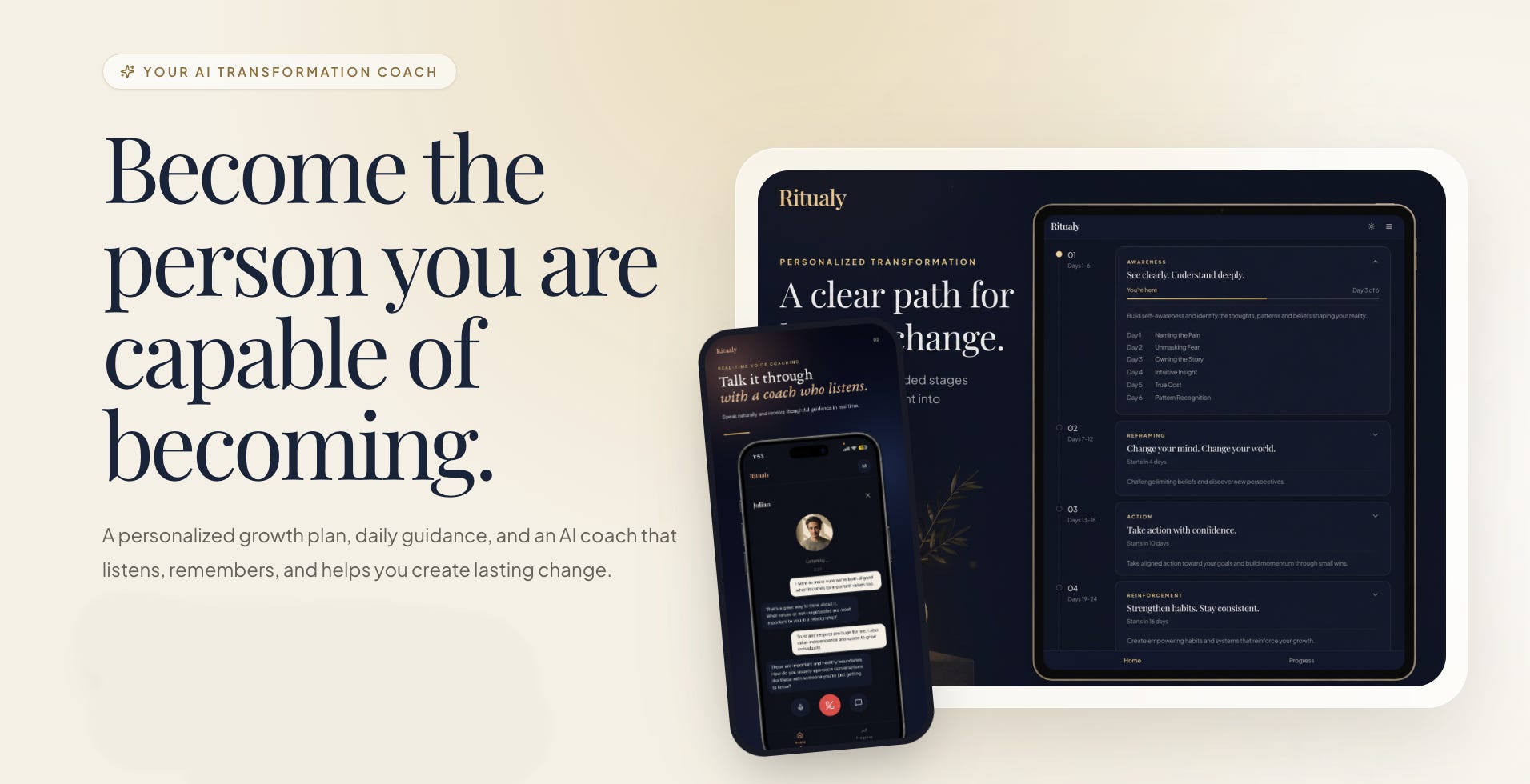
This five-stage process is the foundation of Ritualy.
You begin with something you want to work through — anxiety, a breakup, confidence, procrastination, feeling lost, or something entirely your own. Ritualy creates a personalized 30-day or 12-week journey. You can then choose an AI coach you’d like to work with, who will help you explore what’s underneath, recognize patterns, and move forward through:
Awareness → Reframing → Action → Reinforce → Identity
Your first journey is free, so if there’s something you’ve been wanting to work through, start there.
Once you’ve finished creating your 30-day or 12-week plan, please come back and tell me in the comments which coach you picked. I’d love to know. ☺️